Current situation of The War : USA, Israel VS Iran | Iran on Burst Mode 13 March, 2026
March 13, 2026
WORLD REPORT
Friday, March 13, 2026 | Comprehensive Global News Briefing
THE MIDDLE EAST IN FLAMES
TOP STORY | US–ISRAEL WAR ON IRAN — DAY 14
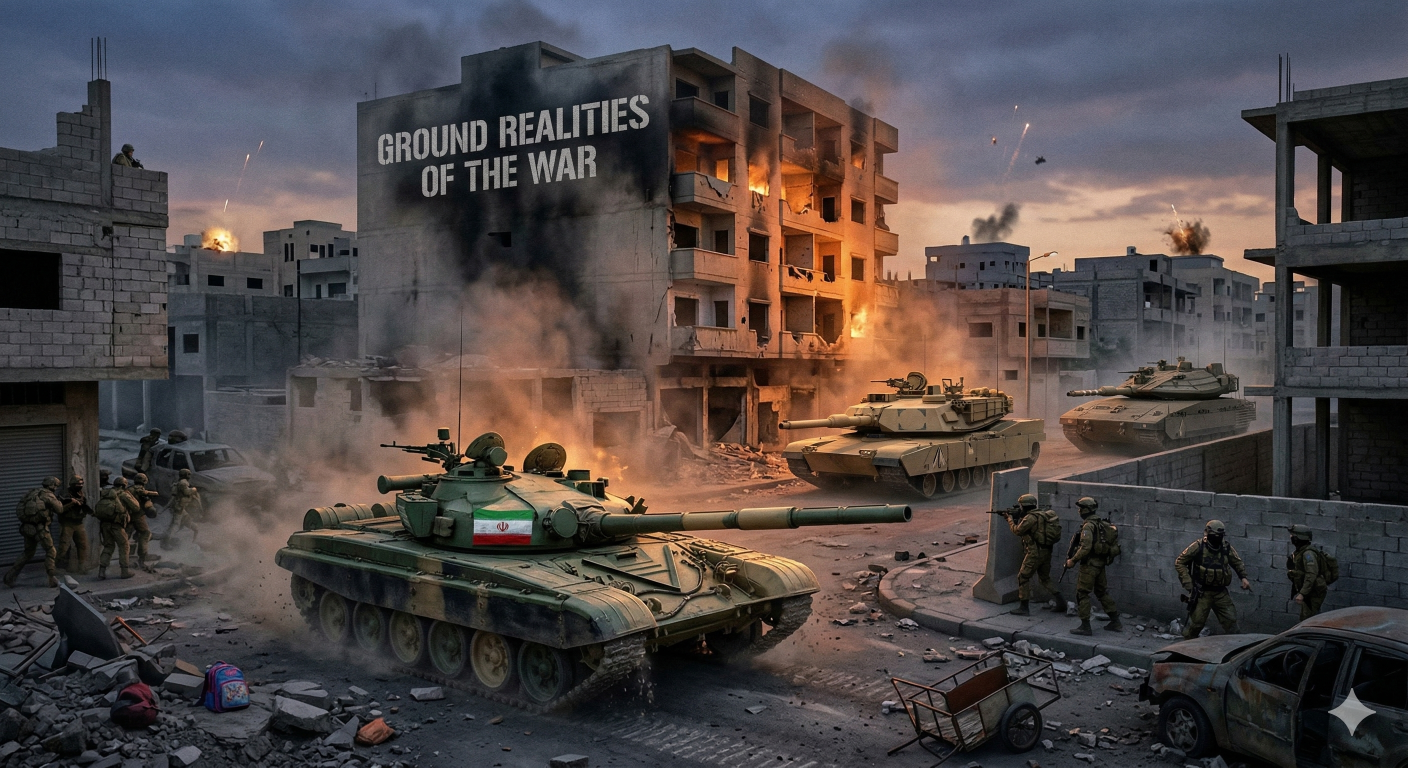
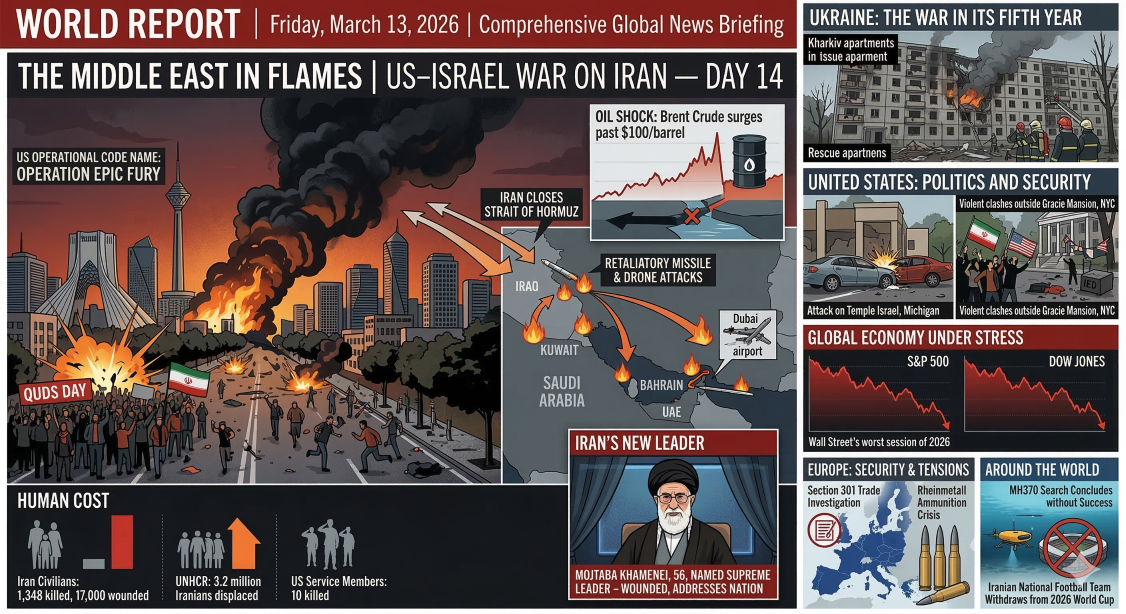
The world woke on Friday, March 13, to the most intense barrage of the two-week-old US–Israel military campaign against Iran. Israel's military announced a sweeping new wave of air strikes on Tehran, sending thick columns of smoke over the Iranian capital even as tens of thousands of Iranians gathered in the streets to mark the annual Quds Day rally. Explosions were reported in the vicinity of the rally, with Iranian state media blaming the US and Israel for a deadly strike that killed at least one person at the demonstration.
The conflict, formally launched on February 28 under the US operational code name 'Operation Epic Fury,' opened with strikes that killed Iran's Supreme Leader, Ayatollah Ali Khamenei — an act that set off a chain of retaliatory missiles and drone attacks across the region. His 56-year-old son, Mojtaba Khamenei, has since been named the new Supreme Leader. US Secretary of Defense Pete Hegseth said on Friday that the younger Khamenei is 'wounded and likely disfigured,' having not appeared on camera but instead issuing his first public address through a state television news anchor.
The human cost has grown staggering. Iran's ambassador to the United Nations reported that at least 1,348 civilians have been killed inside Iran, with more than 17,000 wounded, and the UN refugee agency said up to 3.2 million Iranians have been driven from their homes. More than 570 people have been killed in Lebanon, where Israeli forces have escalated strikes against Hezbollah, and 13 people have died in Israel. Ten US service members have been killed in the conflict, with four more fatalities confirmed on Friday after a KC-135 aerial refueling aircraft went down in western Iraq — a crash the US Central Command said was not caused by hostile fire.
The Strait of Hormuz and the Oil Shock
Iran has closed the Strait of Hormuz, the narrow waterway through which roughly a fifth of global oil consumption normally flows. The closure has sent Brent crude surging past $100 per barrel for the first time since 2022 — settling at $100.46 on Thursday. The International Energy Agency approved a record coordinated release of 400 million barrels from global strategic reserves, with the United States contributing 172 million barrels from its Strategic Petroleum Reserve. Markets have largely shrugged off the announcement, with oil prices barely retreating. In a separate emergency measure, the US Treasury Department temporarily lifted sanctions on Russian crude oil already at sea, allowing stranded shipments to be sold — a move that drew criticism from Ukraine and European allies.
Gulf nations are bearing the brunt of Iran's retaliation. Bahrain has intercepted 114 missiles and 190 drones since the war began. Saudi Arabia's defenses destroyed 28 drones over its eastern region, with additional drone debris falling on Kuwait's electricity transmission infrastructure. The UAE's Dubai International Airport was struck, and Qatar's airspace remains officially closed, with Qatar Airways operating special repatriation flights. Australian officials have ordered non-essential personnel to leave the UAE and Israel and urged citizens to evacuate the broader Middle East while commercial travel is still available.
Iran's New Leader and Conditions for Peace
Iran's new Supreme Leader has vowed to keep the Strait of Hormuz closed and continue attacks on US military bases unless they are shut down. Iranian President Masoud Pezeshkian has outlined three conditions for ending the war: international recognition of Iran's legitimate rights, payment of reparations, and firm guarantees against future attacks. Iran's parliament speaker declared the country is 'certainly not seeking a ceasefire,' while the IRGC stated bluntly that 'Iran will determine when the war ends.' Gulf Arab states — Kuwait, Saudi Arabia, Bahrain, Qatar, the UAE, and Oman — have issued rare united calls for a ceasefire, even as they find their own territory under fire. France confirmed the death of one soldier — the first French and European military fatality of the conflict — after a drone strike hit a base in Iraqi Kurdistan.
UKRAINE: THE WAR IN ITS FIFTH YEAR
CONFLICT UPDATE | UKRAINE–RUSSIA
The war in Ukraine grinds into its fifth year with no ceasefire in sight, even as the parallel Middle East crisis has diverted diplomatic bandwidth from Kyiv to the Gulf. Russia launched a devastating overnight assault on Ukraine's second-largest city, Kharkiv, earlier this week, deploying a cruise missile that collapsed an entire section of a five-storey apartment building and killed at least ten people, among them two children and a primary school teacher. Ukrainian President Volodymyr Zelensky has insisted that battlefield performance, not diplomatic timetables, will shape Ukraine's negotiating position.
Ukraine's General Staff reported that Russian forces have now suffered over 1,276,000 total casualties since February 2022, with 860 personnel eliminated in the last 24-hour reporting period. On the frontlines, Russia lost 57 square miles of Ukrainian territory over the past four weeks — a notable reversal from the 182 square miles it had gained in the preceding month. Ukrainian forces have used British–French Storm Shadow missiles to strike an electronics manufacturing plant in Russia that produces microchips and missile components. Russia blamed the UK for the attack; London declined to comment.
Zelensky has been cultivating an unexpected diplomatic role in the Iran conflict, offering Ukraine's battlefield-tested counter-drone technology to US and Gulf allies. Ukrainian counter-drone teams have reportedly deployed to protect US and allied bases in the Middle East, and Kyiv says it has received 11 official requests for drone interceptors, electronic warfare systems, and training from neighboring countries, European states, and the United States. Ironically, as Ukraine helps defend against Iranian drones, Moscow has been supplying Iran with targeting intelligence for attacks on US troops, warships, and aircraft — a dynamic that has strained Russia's carefully cultivated neutrality posture.
Russia, meanwhile, has earned an estimated additional 6 billion euros ($6.9 billion) in oil revenues over the two weeks of US–Iran fighting, as the Strait of Hormuz closure drives global prices higher. Peace negotiations between Russia and Ukraine remain stalled on territorial questions, with Putin insisting Kyiv must cede the entire Donbas region. Zelensky has said the talks are 'stuck.'
UNITED STATES: POLITICS AND SECURITY
DOMESTIC
Back home, the war is registering across American political and social life. The FBI confirmed on Friday that an attack on Temple Israel synagogue in West Bloomfield, Michigan — in which a gunman rammed a vehicle into the building before being fatally shot by security — was 'a targeted act of violence against the Jewish community.' Investigators noted the suspect had lost family members in an Israeli airstrike in Lebanon the previous week, suggesting the Middle East conflict is fueling domestic radicalization.
In New York City, violent clashes erupted outside Gracie Mansion between far-right protesters objecting to Mayor Zohran Mamdani's Muslim faith and counter-protesters. Police Commissioner Jessica Tisch confirmed that an improvised explosive device — 'not a hoax or smoke bomb,' but a weapon capable of causing 'serious injury or death' — was thrown during the melee, and two people were arrested in connection with the incident.
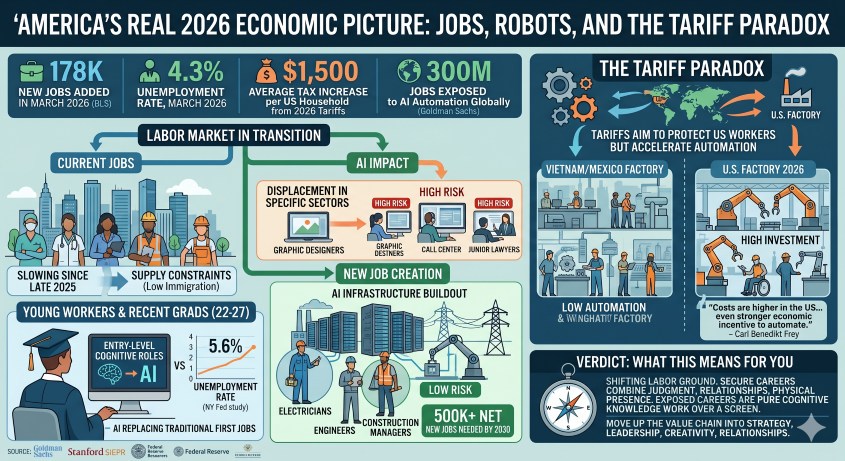
On Capitol Hill, the Senate failed to reach agreement on funding the Department of Homeland Security before lawmakers left for the weekend. Democrats floated a proposal to ensure continued pay for TSA agents, while debate over immigration enforcement changes soured negotiations. US mortgage rates ticked upward to 6.11%, reflecting bond market anxiety tied to war-driven oil price volatility. The US trade deficit for January narrowed sharply to $54.5 billion, well below the $66.6 billion forecast, on record export volumes — though economists caution the figure predates the oil shock and is likely to look worse in coming months.
THE GLOBAL ECONOMY UNDER STRESS
MARKETS & FINANCE
Wall Street posted its worst session of 2026 this week as the oil shock dominated investor sentiment. The S&P 500 fell 1.52% to 6,672.62, the Dow Jones dropped 739 points — falling below 47,000 for the first time this year — and the Nasdaq lost 1.78%. The 10-year Treasury yield climbed to 4.24%, a five-week high, as inflation fears resurfaced. The IEA described the Middle East conflict as generating 'the largest supply disruption in the history of the global oil market.'
European markets also buckled. The DAX fell 1.4%, the FTSE 100 lost 0.6%, and the Stoxx 600 dropped roughly 0.7%, with bank stocks leading declines. Defense contractors bucked the trend: Germany's Rheinmetall guided full-year 2026 sales growth of 40 to 45%, with its order backlog expected to double to 135 billion euros, and Italy's Leonardo surged 7.8% in a single session. Germany released 19.7 million barrels from its strategic oil reserves, and the government capped petrol station price increases to once daily to manage consumer inflation. European fuel prices in Germany have climbed to 2.20 euros per liter. The EU warned that bloc-wide inflation could exceed 3% this year.
In Asia, Japan's manufacturing outlook deteriorated as Strait of Hormuz supply chain disruptions ripple through energy-dependent economies. China faces its worst consumer spending start to a year outside of the COVID period, according to Nomura Holdings economists, who warned that Beijing's reliance on export growth to offset its crashing property market is 'a dilemma that China will have to resolve.' Global insolvencies are projected to rise a further 3 to 4% in 2026, following a 6 to 7% increase last year.
EUROPE: SECURITY, DIPLOMACY, AND TENSIONS
EUROPE
Norway police are investigating last week's explosion at the US Embassy in Oslo as a potential terrorist attack. British Prime Minister Keir Starmer spoke with President Trump after the US president publicly criticized Britain for not immediately backing the Iran strikes. Starmer subsequently allowed the US to use British bases — including RAF Fairford in Gloucestershire, where B-52 and B-1 bombers have since arrived — to launch defensive operations against Iranian missile sites. Rheinmetall's CEO separately warned that Europe is facing a serious ammunition crisis, stating that practically no European country holds adequate weapons stocks.
The US Trade Representative has opened Section 301 trade investigations targeting the European Union alongside 15 other economies. The USTR stated the EU has fulfilled roughly zero percent of its commitments under prior trade agreements with Washington, and aims for remedies by July. Poland's president vetoed legislation implementing the EU's 150-billion-euro SAFE military loans program, citing sovereignty concerns. Hungary has called on the EU to follow the US example of easing sanctions on Russian oil. Senior EU officials warned the Iranian war has already cost European taxpayers an estimated three billion euros in its first ten days, while markets remain unsettled.
AROUND THE WORLD
GLOBAL BRIEFS
In Nepal, rapper-turned-politician Balendra Shah is heading for victory in national elections, unseating a former prime minister in a result that reflects deep public disillusionment with the country's traditional political establishment.
A new undersea search for Malaysia Airlines Flight MH370 has concluded without success, authorities confirmed this week. The aircraft vanished in 2014 with 227 passengers and 12 crew aboard, and remains one of the most enduring mysteries in aviation history.
The Iranian national football team has pulled out of the 2026 FIFA World Cup, which is scheduled to be hosted by the United States, Canada, and Mexico. Iran's sports minister cited the ongoing US military campaign against Iran as the reason. The Iranian soccer team hit back at Trump, suggesting the US should itself face expulsion given its inability to guarantee player safety at a competition it is hosting.
Google has integrated its Gemini AI model into Google Maps, introducing an 'Ask Maps' feature that enables users to ask complex, open-ended local questions — such as finding public sports courts with lighting available at a specific time — and receive answers with custom maps, a task the company says would previously have required extensive manual searching through reviews.
This briefing was compiled from reporting by Al Jazeera, NPR, NBC News, CNN, ABC News, the BBC, The Guardian, the Kyiv Independent, and other news organisations. All casualty and battlefield figures are subject to revision as the situation evolves.
© World Report — March 13, 2026