The Crypto World Right Now — Chaos, Charts & What’s Coming Next March 11, 2026 | Bitcoin, Altcoins, Regulation & The Events That Could Change Everything
March 11, 2026
₿ The Crypto World Right Now — Chaos, Charts & What’s Coming Next
March 11, 2026 | Bitcoin, Altcoins, Regulation & The Events That Could Change Everything
In a neon-lit trading room somewhere, a chart flips red. Then green. Then red again. A billion dollars moves in the time it takes to blink. Welcome to crypto in 2026 — where the drama never sleeps.
Chapter 1: Bitcoin Is Having a Moment — Not a Good One
Let’s set the scene.
Just a few months ago, Bitcoin was dancing above $100,000. Euphoria everywhere. The halving cycle was playing out like clockwork. Institutional money was flowing in. Everyone was bullish.
Then the world got complicated.
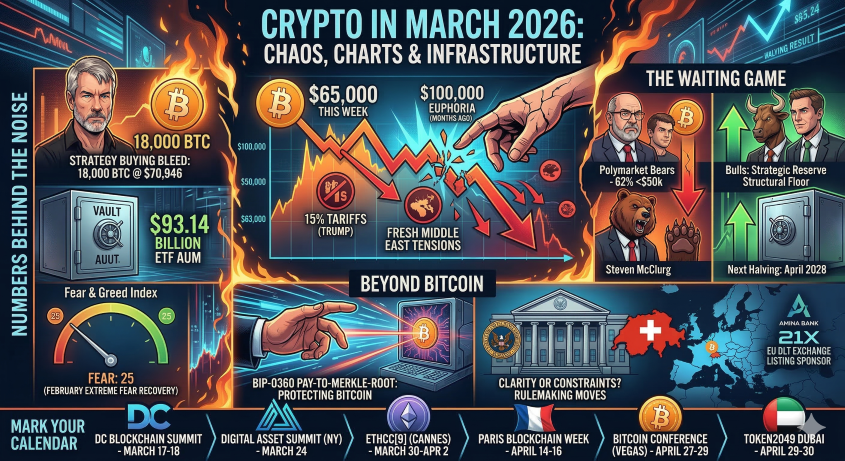
Bitcoin fell back to $65,000 this week — driven by President Trump’s announcement of new 15% global tariffs and the eruption of fresh Middle East tensions. Both events triggered a broad flight from risk assets, pulling crypto and equities down together. When fear grips the markets, Bitcoin tends to be one of the first exits.
Crypto-adjacent stocks felt it too — Strategy fell 1.64%, Coinbase 1.55%, Robinhood 1.33%, and Block dropped nearly 1% in the same session. This wasn’t sector-specific turbulence. It was a coordinated pullback from anything that smells like risk.
As of today, March 11, the Crypto Fear & Greed Index sits at 25 — still in “Fear” territory, though it’s climbed slightly from the “Extreme Fear” levels of last month. The market is nervous, but it’s not panicking the way it was in February.
Chapter 2: The Numbers Behind the Noise
Here’s what the data actually says, beneath all the emotion.
U.S. spot Bitcoin ETFs have seen net inflows over the past week, with total assets under management sitting at $93.14 billion as of today. That’s not a number you throw away. Consistent ETF inflows mean institutional money is still showing up — quietly, methodically — even as retail sentiment sours.
Meanwhile, Strategy — led by Michael Saylor — purchased nearly 18,000 BTC for approximately $1.28 billion between March 2 and 8, at an average price of around $70,946. When the market is bleeding, some of the biggest players are still buying.
Earlier this month, Bitcoin briefly spiked toward $74,000 after the Iran strikes, as some investors rotated into crypto during macro chaos — a sign that the “digital gold” narrative still has real believers. But the rally didn’t hold, and analysts cautioned it was driven more by short-covering than fresh demand.
Where does it go from here? Bitcoin is currently trading in a key range — with resistance near $67,600 and $70,800 on the upside, and critical support at $65,600 on the downside. A decisive break below that could send prices toward the $59,500 region. In other words: it’s a knife-edge moment.
Chapter 3: The Bears, the Bulls & the Waiting Game
The debate raging in crypto right now is loud, messy, and genuinely unresolved.
On the bearish side, Canary Capital CEO Steven McClurg told CNBC he expects Bitcoin to fall as low as $50,000 in the summer, calling 2026 “a bear leg to the four-year cycle.” Standard Chartered has echoed this view.
Polymarket data shows 62% of users believe Bitcoin will fall below $50,000 at some point this year — a remarkable level of pessimism for an asset that was above $100,000 just months ago.
But the bulls aren’t quiet either. They point to the U.S. Strategic Bitcoin Reserve as a structural floor that previous bear cycles never had. ETF inflows keep ticking. Whales keep accumulating. And the next halving — estimated for April 2028 — is already being penciled into long-term models.
Some analysts now believe Bitcoin found its lowest point for 2026 when it dropped around $60,000 — noting that this cycle’s drawdown of roughly 52% from all-time highs was far shallower than past crashes, which saw drops of 80–90%.
The truth? Nobody really knows. But the structure of the market is more interesting than it’s been in a while.
Chapter 4: Beyond Bitcoin — The Wider Crypto World
Quantum Computing vs. Bitcoin’s Code
A proposal called Pay-to-Merkle-Root (BIP-0360) was formally merged into Bitcoin’s improvement proposals in February 2026. It’s designed to protect against future quantum computing threats by removing a quantum-vulnerable spending option from Bitcoin’s Taproot outputs. It’s not an urgent fix — quantum computers can’t crack Bitcoin today — but it signals that the protocol is actively evolving. The future is being built now.
The SEC Moves on Crypto Regulation
The U.S. Securities and Exchange Commission has introduced a proposal explaining how existing securities laws may apply to certain crypto assets and transactions — suggesting the agency is ready to act without waiting for Congress. For the industry, it’s a double-edged sword: clarity, yes, but also constraints.
Europe Gets Its First Regulated DLT Exchange
AMINA Bank — a crypto bank regulated by Switzerland’s FINMA — has become the first regulated bank to serve as a listing sponsor on 21X, the EU’s inaugural fully regulated trading and settlement system for distributed ledger technology. It’s a small step, but it’s the kind of institutional infrastructure that reshapes the long game.
Solana, Chainlink & the Altcoin Pulse
Earlier this month, Solana, Chainlink, and Pepe led a brief altcoin rally as traders rotated back into risk assets. It didn’t last, but it showed that appetite for the broader market is still alive — just waiting for the right moment.
Chapter 5: Mark Your Calendar — The Events That Matter
If you want to understand where crypto is heading, pay attention to where the industry gathers. Here’s what’s coming up:
🗓 DC Blockchain Summit — March 17–18, Washington DC The Chamber of Digital Commerce hosts lawmakers, regulators, and industry leaders to tackle the most pressing policy issues in blockchain. The theme this year is “Blockchain for a Better Tomorrow.” Given the SEC’s recent moves, this one could be defining.
🗓 Digital Asset Summit — March 24, New York This event targets institutional investors, banks, and infrastructure providers — with sessions on market structure, custody, compliance, and risk for large-scale digital asset portfolios. Follow the money, follow this summit.
🗓 EthCC[9] — March 30 to April 2, Cannes, France Europe’s largest and longest-running Ethereum conference lands on the French Riviera for four intense days of talks, workshops, networking and a dedicated pitch track connecting startups with leading VCs. If Ethereum is your world, this is your Super Bowl.
🗓 Paris Blockchain Week — April 14–16, Paris Held at the Carrousel du Louvre, this event draws 10,000+ attendees and 420+ speakers covering MiCA regulation, stablecoins, tokenization, and the intersection of traditional finance with blockchain. The grown-up room of crypto.
🗓 Bitcoin Conference — April 27–29, Las Vegas The flagship global gathering dedicated exclusively to Bitcoin, taking place at The Venetian. The audience brings together developers, miners, institutional allocators, and ecosystem founders — making it the largest single-platform for the Bitcoin community. High-profile announcements, big keynotes, and the kind of energy that sets the narrative for the year.
🗓 TOKEN2049 Dubai — April 29–30 Positioned as a critical bridge between East and West, TOKEN2049 Dubai focuses on business development and institutional access in the heart of the MENA region, bringing together high-conviction funds, exchanges, and founders.
Epilogue: Where Is All of This Going?
Zoom out. Take a breath.
Crypto in March 2026 is caught between two very real forces: the short-term chaos of geopolitics and macro shocks, and the long-term structural build of institutions, regulation, and real technology.
The price is wobbly. The sentiment is fearful. But the infrastructure is quietly growing — ETFs, regulated exchanges, quantum-resistant protocols, and a global conference circuit that never stops.
The story of crypto is still being written. And right now, the pen is in the air.
📌 Bookmark this page. The next chapter drops tomorrow.